
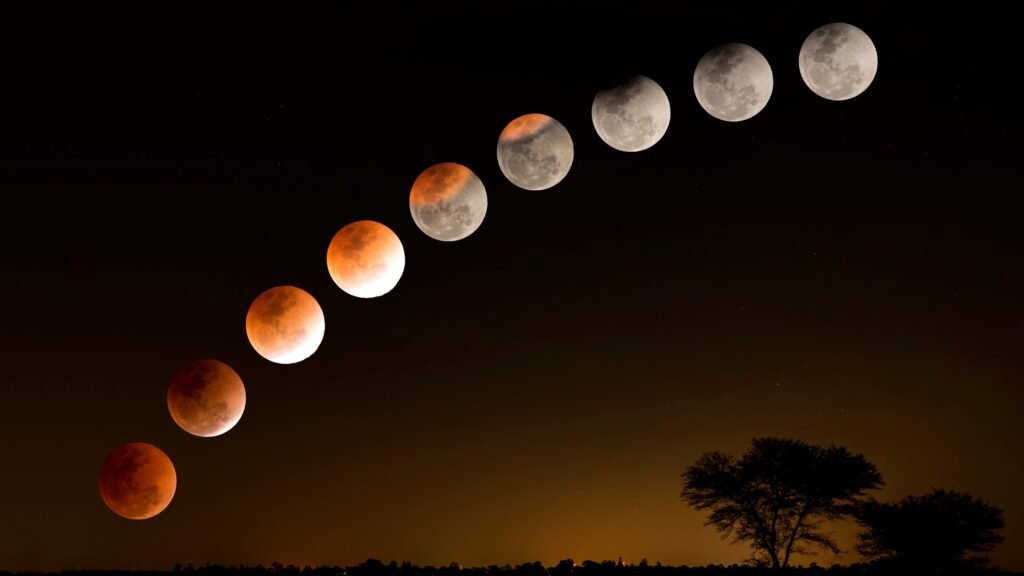
A spectacular celestial event is set to captivate skywatchers as a total lunar eclipse transforms the Moon into a glowing red orb in the overnight sky. Often referred to as a “Blood Moon,” this rare phenomenon is both visually stunning and scientifically fascinating.
In this SEO-optimized article, we explain what a total lunar eclipse is, why the Moon turns red, when to watch it, and how to get the best view.
What Is a Total Lunar Eclipse?
A total lunar eclipse occurs when the Earth moves directly between the Sun and the Moon, casting a shadow that completely covers the Moon. This alignment happens only during a full moon and under precise conditions.
Unlike solar eclipses, lunar eclipses are safe to watch with the naked eye, making them accessible to everyone.
Why Does the Moon Turn Red?
During a total lunar eclipse, the Moon doesn’t disappear completely. Instead, it takes on a reddish or copper color. This happens due to a scientific effect called Rayleigh scattering.
As sunlight passes through Earth’s atmosphere:
- Shorter blue wavelengths are scattered
- Longer red wavelengths pass through and bend toward the Moon
- The Moon reflects this red light back to Earth
This is the same reason sunsets appear red, creating the dramatic “Blood Moon” effect.
When Will the Eclipse Be Visible?
The exact timing of the eclipse depends on your location, but generally, the event occurs overnight and can last several hours.
The main stages include:
- Penumbral phase (subtle shading begins)
- Partial eclipse (Moon starts to darken)
- Total eclipse (Moon turns red)
- Return phases (Moon gradually brightens again)
For the best experience, check your local time zone for precise viewing hours.
How to Watch the Lunar Eclipse
Watching a lunar eclipse is simple and requires no special equipment:
- Find a location with clear skies
- Avoid areas with heavy light pollution
- Look toward the night sky during peak hours
- Use binoculars or a telescope for a closer view
Even without equipment, the red Moon is clearly visible.
Best Places to View the Blood Moon
The eclipse will be visible across large parts of the world, depending on timing. Ideal viewing locations include:
- Areas with minimal cloud cover
- Rural or open spaces
- Elevated locations like hills
Clear skies are the most important factor for a great viewing experience.
Why This Event Is Special
Total lunar eclipses don’t happen every month, making them a special event for sky enthusiasts. The deep red color, combined with the stillness of the night, creates a unique and memorable experience.
For photographers, it’s also a perfect opportunity to capture stunning images of the night sky.
Scientific Importance of Lunar Eclipses
Beyond their beauty, lunar eclipses are important for science:
- They help astronomers study Earth’s atmosphere
- Provide insights into light behavior and scattering
- Offer opportunities to observe the Moon in different lighting conditions
These events continue to contribute to our understanding of space.
Tips for Capturing the Red Moon
If you want to photograph the eclipse:
- Use a tripod for stability
- Set a low ISO and longer exposure
- Zoom in with a telephoto lens
- Capture different phases of the eclipse
Planning ahead will help you get the best results.
A total lunar eclipse turning the Moon red is one of nature’s most breathtaking displays. Whether you’re an astronomy enthusiast or just curious, this event offers a chance to witness something truly extraordinary.
Mark your calendar, look up at the night sky, and enjoy the magical sight of the Blood Moon.
What is a Blood Moon?
It is the reddish appearance of the Moon during a total lunar eclipse.
Is it safe to watch a lunar eclipse?
Yes, it is completely safe to view with the naked eye.
Why does the Moon turn red?
Due to Rayleigh scattering, which filters sunlight through Earth’s atmosphere.
How long does a total lunar eclipse last?
The full event can last several hours, with totality lasting about 1–2 hours.
Do I need special equipment to watch it?
No, but binoculars or a telescope can enhance the view.